Can You Wash Dishes During a Boil Water Advisory? Safe Methods That Actually Work

The notice arrives mid-morning: the water system lost pressure after a main break, and until further notice everyone in the neighborhood should boil tap water before using it. You read the list — drinking, cooking, brushing teeth — and then you look at the sink. Breakfast dishes are stacked up. Dinner is still coming. Is the dishwasher off-limits for the next two days?
The short answer is that you can keep washing dishes during a boil water advisory. You just cannot do it the way you normally do, with hot tap water and a sponge, because that is exactly how contaminated water ends up on a surface that later touches food.
This guide covers the two methods that public health agencies consider safe, the parts of dishwashing people get wrong, and the specific cases — baby bottles, cutting boards, pet bowls — that need extra attention.
The short answer
Hand washing: safe if you wash and rinse with boiled water that has cooled, or with bottled water, and sanitize afterwards in a mild bleach solution.
Dishwasher: safe if your machine has a sanitizing cycle or a final rinse that reaches at least 150 °F (66 °C). Check the manual — many household units never hit that temperature, and then the machine is only a drying rack.
Not safe: rinsing dishes under the tap, soaking pots in tap water, wiping counters with a sponge rinsed in tap water, or “just this once” using tap water because the dishes look clean.
Why dishwashing is riskier than it looks
Waterborne pathogens such as E. coli, Giardia, Cryptosporidium, norovirus and Shigella are spread by the fecal-oral route. You do not have to drink a glass of contaminated water to get sick. A thin film of it on a plate, a fork or a cutting board is enough, especially if that surface then holds food that is not cooked again.
Three things make dishwashing a high-risk chore:
Warm, wet surfaces. Bacteria survive longer on a damp sponge than on a dry plate. A sponge that sits in a sink all day is the perfect reservoir.
Cross-contamination. If you wash dishes in contaminated water and then dry them with a towel, you move the contamination from the sink to the towel to the next dish.
Low temperatures. Home hand-washing rarely reaches the temperatures that kill pathogens. The water feels hot to your hands at 110 °F (43 °C), which is far below the 150 °F (66 °C) that sanitizing requires.
That is why the advice is not “wash carefully” but “change the water you wash with.”
Method 1: hand washing with boiled or bottled water
This is the method to use if you do not have a dishwasher, or if your machine lacks a sanitizing cycle. It takes about ten minutes longer than normal and uses more water, but it is straightforward.
- Boil enough water first. Bring tap water to a rolling boil for one minute, then let it cool. Above 6,500 feet, boil for three minutes. Do not boil more than you can handle safely; a large pot of boiling water in a small kitchen is its own hazard.
- Set up three stations. One basin or bowl with hot soapy water made from boiled or bottled water, one with clean boiled water for rinsing, and a drying rack.
- Scrape food into the trash, not the sink. Food residue uses up the sanitizer and clogs the drain.
- Wash in the soapy basin. Use a clean cloth or a sponge that has not been used with tap water since the advisory started.
- Rinse in the second basin. Do not top it up from the tap.
- Sanitize. Add one teaspoon of unscented household liquid chlorine bleach per gallon of warm water and soak the rinsed dishes for at least one minute. That is the CDC figure; some state health departments specify a stronger one-tablespoon-per-gallon solution, so follow the notice you received if it is more specific.
- Air dry. Stand items on a rack so water runs off. Do not towel-dry; a towel is another surface that can carry contamination.
If you cannot boil water — because the power is out, for example — use bottled water for washing and rinsing, and keep a separate bottle for the sanitizing dip.

Method 2: the dishwasher
A dishwasher is the easier option, but only under certain conditions.
Check for a sanitizing cycle. Most modern machines have a “sanitize” or “high temp” option that raises the final rinse to at least 150 °F (66 °C). If yours has it, run the heaviest cycle you have and use it.
Use a heated dry cycle. The drying phase adds another chance for pathogens to be killed. If your machine has no heated dry, open the door at the end and let the dishes air dry fully.
Do not overcrowd. Water needs to reach every surface.
Skip the pre-rinse in the sink. Scrape food into the trash instead. Pre-rinsing under the tap is the single most common way people accidentally expose themselves during an advisory.
Run an empty hot cycle afterwards if you used the machine during the advisory and want to be thorough — especially if anyone in the house has been sick.
If your dishwasher has no sanitizing option, treat it as a drying rack: wash by hand with the method above, and use the machine only for storage.
The mistakes that undo the work
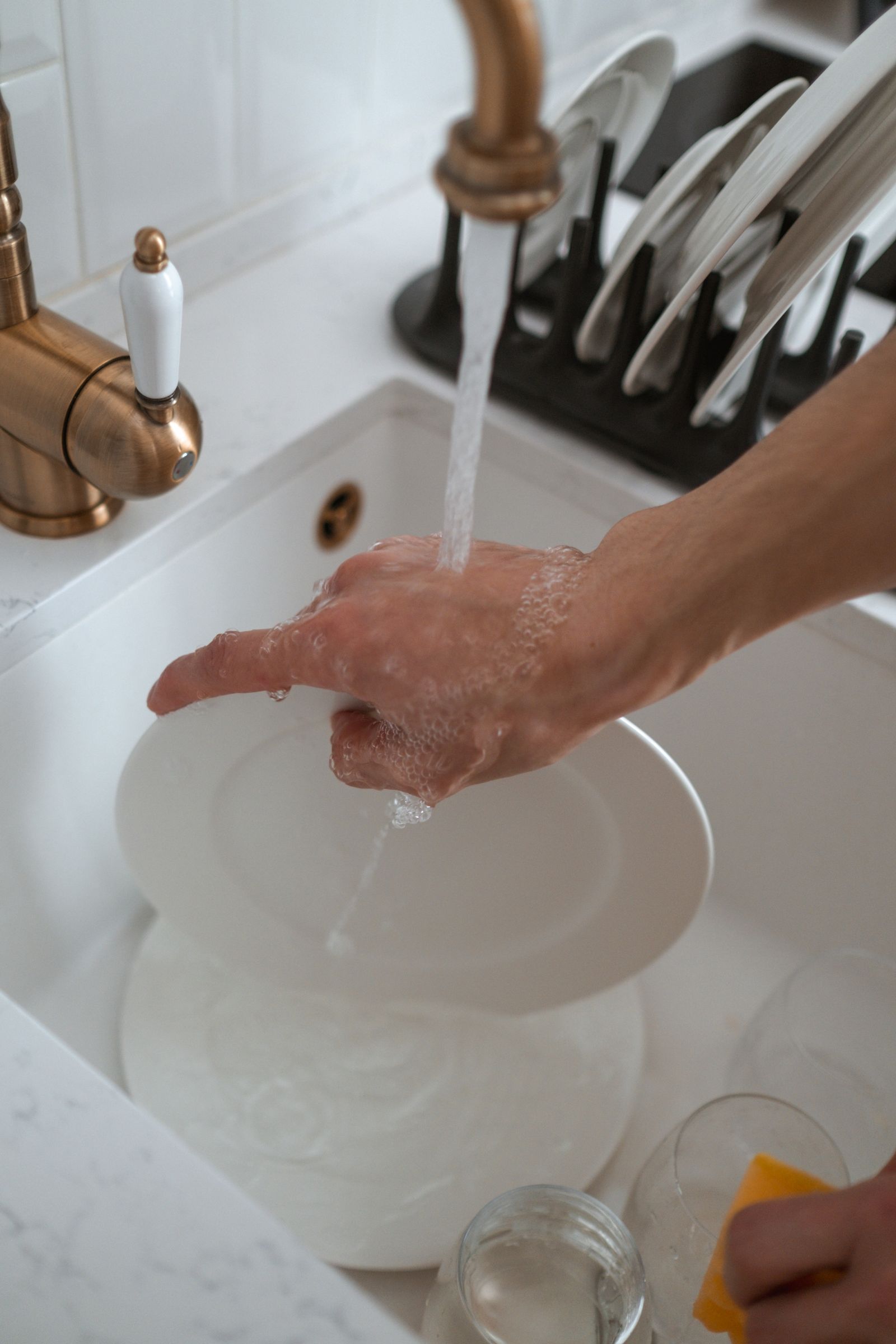
- Rinsing “just the soap off” under the tap. That single step recontaminates everything.
- Using the same sponge all week. Sponges hold water and food particles. Use a clean cloth per cycle, or paper towels you throw away.
- Drying with a shared towel. Air drying is safer.
- Washing dishes in a sink full of tap water with soap and assuming the soap kills germs. Soap lifts dirt; it does not reliably disinfect.
- Forgetting the sink itself. Wipe the basin, the faucet handle and the drain area with the bleach solution after washing dishes.
Special cases
Baby bottles and nipples. Wash with boiled or bottled water, then sterilize by boiling for five minutes or using a steam sterilizer. Do not rinse under the tap. More on this in our guide to formula feeding during a boil water advisory.
Cutting boards. Wooden boards can absorb contaminated water. After washing, sanitize with the bleach dip and let them dry completely before the next use. Better still, use a plastic board during the advisory.
Pet bowls. Wash them with boiled or bottled water, and give pets boiled-and-cooled or bottled water too. See can pets drink tap water during a boil water advisory.
Pots and pans that held contaminated water. If you boiled tap water in a pot, the pot itself is fine after normal washing with safe water. Boiling kills pathogens; it does not make the pot dangerous.
Coffee makers and kettles. Do not run tap water through them. Use bottled or boiled water, and clean the reservoir afterwards. Our guide to coffee makers, ice machines and soda fountains covers the equipment details.

When the advisory is lifted
The advisory is over when the utility says it is over — not when the water looks clear. Once it is lifted, spend twenty minutes resetting your kitchen:
- Run every tap, hot and cold, for several minutes. Start with the lowest faucet in the house.
- Run the dishwasher empty on a hot cycle.
- Throw out the sponge and the dishcloth you used during the advisory.
- Clean the sink, the drain and the faucet handles with a disinfectant.
- Discard ice from the freezer and clean the bin.
- Replace any water filter cartridge that was in use during the advisory.
A full checklist is in our guide to what to do after a boil water advisory is lifted.
Frequently asked questions
Can I use the dishwasher if it does not have a sanitizing cycle? Only as a drying rack. Without a cycle that reaches 150 °F in the final rinse, the machine does not disinfect.
Can I wash dishes with bottled water only? Yes. Use one bottle for washing and one for rinsing, and add the bleach dip if you want to be certain.
Do I need to boil water for washing dishes if I am going to cook the food afterwards? It depends on the food. Dishes used for raw or ready-to-eat food need safe water. A pot that will be boiled for ten minutes is less risky, but the pot itself still needs to be washed safely before it is stored.
How much bleach is safe? For sanitizing dishes, CDC specifies one teaspoon of unscented household liquid bleach per gallon of warm water, soaked for at least one minute; some states specify one tablespoon. Use unscented bleach with no added cleaners, and never mix it with ammonia or vinegar.
What if my water notice is a “do not use” order instead? Stop using tap water for anything, including washing dishes. That is a different emergency — see boil water advisory vs. order.
Bottom line
You do not have to eat off paper plates for three days. Wash dishes with boiled-and-cooled or bottled water, sanitize with a mild bleach solution, air dry, and keep tap water out of the process entirely. If you have a dishwasher with a sanitizing cycle, use it and skip the sink. When the advisory lifts, reset the kitchen: taps, dishwasher, sponges, sink, ice.
For the complete household checklist during an advisory, start with what to do during a boil water advisory, and check whether your area is under a notice on our live notices page.
Sources
- CDC, *Boil Water Advisory* guidance for households: https://www.cdc.gov/water-emergency/about/index.html
- CDC, *Food and Water Safety During Power Outages and Floods*: https://www.foodsafety.gov/food-safety-charts/food-safety-during-power-outage
- EPA, *Emergency Disinfection of Drinking Water*: https://www.epa.gov/ground-water-and-drinking-water/emergency-disinfection-drinking-water
- Your local health department’s boil water guidance, which may set stricter rules than the federal minimum.
 Disinfecting Without Bleach: What Actually Works During a Boil Water Advisory
 Takeout and Delivery During a Boil Water Advisory: What to Order, What to Skip
 Cooking Pasta, Rice and Soup During a Boil Water Advisory